How to Negotiate Rentin Malviya Nagar: A Practical Guide for Tenants
Tenants in Malviya Nagar can negotiate rent by researching comparable flats, timing the search when landlords are more flexible, offering reliable payment terms and making a specific, polite offer. Discounts are not guaranteed, and the final rent depends on the flat, demand and the landlord’s expectations.

Key takeaways
→ Landlords are most flexible when a flat has been vacant for weeks or a renewal is due.
→ Three to five comparable listings give you stronger leverage than a general claim that the rent is high.
→ Deposit, maintenance and yearly rent increase can matter as much as the monthly rent.
→ Never trade away safety repairs, a written agreement or clear refund terms for a small discount.
→ Put every agreed term in writing before paying.
→ Three to five comparable listings give you stronger leverage than a general claim that the rent is high.
→ Deposit, maintenance and yearly rent increase can matter as much as the monthly rent.
→ Never trade away safety repairs, a written agreement or clear refund terms for a small discount.
→ Put every agreed term in writing before paying.
Why negotiating rent in Malviya Nagar is possible
You find a 2 BHK in Malviya Nagar that ticks every box, but the landlord asks ₹5,000 more than your budget. Do you walk away or negotiate? In most cases, you can ask, provided you go in prepared.
Malviya Nagar is a popular South Delhi locality because of its Yellow Line metro station, busy markets and access to Saket, Hauz Khas and the IIT Delhi area. That demand keeps asking rents high, but asking rents are not always final rents.
This guide covers how to research the market, spot the right moment, make a fair offer and negotiate the deposit, maintenance and yearly increases. It also explains what not to push too hard on.
1. What affects rent in Malviya Nagar?
Rents in the same locality can vary widely. These factors usually shape the asking price:
→ Metro and market access: Flats within walking distance of Malviya Nagar Metro Station or the main market often ask for more.
→ Nearby hubs: Saket (Select Citywalk, hospitals), Hauz Khas and IIT Delhi draw students and working professionals.
→ Building type: Independent builder floors, society flats and older buildings are priced differently.
→ Floor and facilities: Parking, a lift, power backup and terrace access change the price.
→ Furnishing and condition: Furnished, semi-furnished and unfurnished flats sit in different price bands.
To see how prices differ across nearby areas, compare current listings for Malviya Nagar flat rent with apartments for rent in South Delhi. Larger or differently priced options, such as homes for rent in Paryavaran Complex, can also give you a useful comparison point.
Table: Malviya Nagar rent snapshot
Malviya Nagar is a popular South Delhi locality because of its Yellow Line metro station, busy markets and access to Saket, Hauz Khas and the IIT Delhi area. That demand keeps asking rents high, but asking rents are not always final rents.
This guide covers how to research the market, spot the right moment, make a fair offer and negotiate the deposit, maintenance and yearly increases. It also explains what not to push too hard on.
1. What affects rent in Malviya Nagar?
Rents in the same locality can vary widely. These factors usually shape the asking price:
→ Metro and market access: Flats within walking distance of Malviya Nagar Metro Station or the main market often ask for more.
→ Nearby hubs: Saket (Select Citywalk, hospitals), Hauz Khas and IIT Delhi draw students and working professionals.
→ Building type: Independent builder floors, society flats and older buildings are priced differently.
→ Floor and facilities: Parking, a lift, power backup and terrace access change the price.
→ Furnishing and condition: Furnished, semi-furnished and unfurnished flats sit in different price bands.
To see how prices differ across nearby areas, compare current listings for Malviya Nagar flat rent with apartments for rent in South Delhi. Larger or differently priced options, such as homes for rent in Paryavaran Complex, can also give you a useful comparison point.
Table: Malviya Nagar rent snapshot

Ranges reflect asking rents on one listing portal, not final agreed rents. Rents vary by block, building type, floor and furnishing. Verify current listings before making an offer.
2. Set your budget and walk-away limit first
Decide your numbers before you see a single flat:
→ Maximum monthly rent: Many people keep rent within roughly 30% to 35% of take-home pay, though this varies by household.
→ Flat type: 1 RK, 1 BHK, 2 BHK or 3 BHK.
→ Furnishing: Furnished, semi-furnished or unfurnished.
→ Must-haves: Parking, a lift, power backup or a balcony.
→ Length of stay: Short term or a year or more.Keep your maximum budget private. A landlord’s asking price should not set your budget.
3. When are landlords more willing to negotiate?
Landlords are not equally flexible all year. Your chances improve in these situations:
→ The flat has been vacant for weeks. An empty flat earns nothing.
→ Demand is slower: Rental demand near colleges and offices often rises when classes start and companies hire, so searching outside those periods may help. This is a general pattern, not a guarantee.
→ A tenant is leaving or a renewal is due. Many landlords prefer a reliable tenant over the cost and delay of finding a new one.
→ You can move in quickly with your documents ready.
→ The listing appears repeatedly across portals or brokers.None of these guarantees a discount. They only improve your odds.
4. How does vacancy duration affect rent?
Vacancy is one of the strongest negotiation factors.
Ask politely:
“Is the flat available immediately? How long has it been listed?”
Illustrative example: A ₹25,000 flat that stays empty for one month loses the landlord ₹25,000. Offering ₹23,500 on an 11-month agreement costs the landlord ₹16,500 across the year (₹1,500 × 11) but secures a tenant right away. Frame your offer as a quick, hassle-free deal.These figures are for illustration only, not verified Malviya Nagar rents.
5. Can property age and condition lower the rent?
Yes, if the issues are real and visible. Mention them factually, not as criticism.
Common examples:
→ No lift on an upper floor
→ Dated wiring, fittings or bathrooms
→ Seepage or dampness
→ Limited parking or weak water supply.
You could say: “The flat needs some repair work. Would you consider ₹X?” Newer or recently renovated flats usually justify higher rent, so compare like with like.
Inspect the flat before making a final offer:
→ Plumbing and water pressure
→ Electrical points and AC condition
→ Paint, seepage and dampness
→ Whether furniture and appliances work.
Document any damage and get agreed repairs in writing. A lower rent does not automatically cover repair costs.
6. How does furnishing affect negotiation?
Furnishing often adds a premium to rent.
You can use it in three ways:
→ Remove items you do not need, such as an extra bed or an old sofa, and ask whether the rent can come down.
→ Question worn or broken items. Non-working appliances are a fair reason to discuss the furnished premium.
→ Compare total cost. If a semi-furnished flat is cheaper, add the cost of any furniture you would need to buy before deciding.
7. How do competing listings help you negotiate?
→ A specific comparison works better than saying “other flats are cheaper.”
→ Shortlist three to five flats with similar size, floor, furnishing and distance from the metro.
→ Note their asking rents and what they include.
→ Share two or three comparisons with the landlord.
→ Mention only flats you have actually seen or checked.
Asking prices are not final deal prices, so treat listings as a starting point. A bluff is easy to spot and can damage trust.
8. How to make a realistic opening offer
An extremely low offer without a reason can end the conversation.
Instead:
→ Know your maximum rent.
→ Compare the asking price with similar flats.
→ Factor in condition and facilities.
→ Open with an offer that leaves room to move.
Illustrative example: A flat is listed at ₹25,000. Two similar flats are listed at ₹23,000 and ₹24,000, and your maximum is ₹24,000. You could open at ₹23,000 and be ready to settle near ₹24,000 if the flat suits you.
Sample script:
“I like the flat and the location. I have compared a few similar properties, and some are listed at slightly lower rents. Would you consider ₹23,500 per month?”
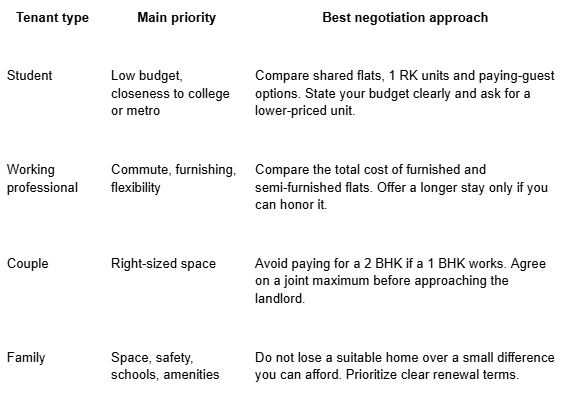
9. Negotiation strategy by tenant type
2. Set your budget and walk-away limit first
Decide your numbers before you see a single flat:
→ Maximum monthly rent: Many people keep rent within roughly 30% to 35% of take-home pay, though this varies by household.
→ Flat type: 1 RK, 1 BHK, 2 BHK or 3 BHK.
→ Furnishing: Furnished, semi-furnished or unfurnished.
→ Must-haves: Parking, a lift, power backup or a balcony.
→ Length of stay: Short term or a year or more.Keep your maximum budget private. A landlord’s asking price should not set your budget.
3. When are landlords more willing to negotiate?
Landlords are not equally flexible all year. Your chances improve in these situations:
→ The flat has been vacant for weeks. An empty flat earns nothing.
→ Demand is slower: Rental demand near colleges and offices often rises when classes start and companies hire, so searching outside those periods may help. This is a general pattern, not a guarantee.
→ A tenant is leaving or a renewal is due. Many landlords prefer a reliable tenant over the cost and delay of finding a new one.
→ You can move in quickly with your documents ready.
→ The listing appears repeatedly across portals or brokers.None of these guarantees a discount. They only improve your odds.
4. How does vacancy duration affect rent?
Vacancy is one of the strongest negotiation factors.
Ask politely:
“Is the flat available immediately? How long has it been listed?”
Illustrative example: A ₹25,000 flat that stays empty for one month loses the landlord ₹25,000. Offering ₹23,500 on an 11-month agreement costs the landlord ₹16,500 across the year (₹1,500 × 11) but secures a tenant right away. Frame your offer as a quick, hassle-free deal.These figures are for illustration only, not verified Malviya Nagar rents.
5. Can property age and condition lower the rent?
Yes, if the issues are real and visible. Mention them factually, not as criticism.
Common examples:
→ No lift on an upper floor
→ Dated wiring, fittings or bathrooms
→ Seepage or dampness
→ Limited parking or weak water supply.
You could say: “The flat needs some repair work. Would you consider ₹X?” Newer or recently renovated flats usually justify higher rent, so compare like with like.
Inspect the flat before making a final offer:
→ Plumbing and water pressure
→ Electrical points and AC condition
→ Paint, seepage and dampness
→ Whether furniture and appliances work.
Document any damage and get agreed repairs in writing. A lower rent does not automatically cover repair costs.
6. How does furnishing affect negotiation?
Furnishing often adds a premium to rent.
You can use it in three ways:
→ Remove items you do not need, such as an extra bed or an old sofa, and ask whether the rent can come down.
→ Question worn or broken items. Non-working appliances are a fair reason to discuss the furnished premium.
→ Compare total cost. If a semi-furnished flat is cheaper, add the cost of any furniture you would need to buy before deciding.
7. How do competing listings help you negotiate?
→ A specific comparison works better than saying “other flats are cheaper.”
→ Shortlist three to five flats with similar size, floor, furnishing and distance from the metro.
→ Note their asking rents and what they include.
→ Share two or three comparisons with the landlord.
→ Mention only flats you have actually seen or checked.
Asking prices are not final deal prices, so treat listings as a starting point. A bluff is easy to spot and can damage trust.
8. How to make a realistic opening offer
An extremely low offer without a reason can end the conversation.
Instead:
→ Know your maximum rent.
→ Compare the asking price with similar flats.
→ Factor in condition and facilities.
→ Open with an offer that leaves room to move.
Illustrative example: A flat is listed at ₹25,000. Two similar flats are listed at ₹23,000 and ₹24,000, and your maximum is ₹24,000. You could open at ₹23,000 and be ready to settle near ₹24,000 if the flat suits you.
Sample script:
“I like the flat and the location. I have compared a few similar properties, and some are listed at slightly lower rents. Would you consider ₹23,500 per month?”
9. Negotiation strategy by tenant type
10. Can a longer lease get you lower rent?
→ It can help, but it is not guaranteed.
→ A longer commitment reduces the landlord’s risk of vacancy and brokerage costs.
→ Offer a longer stay only if you can honor it.
→ Ask for the lower rent to be written into the agreement.
→ Check the lock-in period, notice period and early-termination terms.
If you plan to stay in Delhi NCR for years, you may also want to compare rent with buying. Reading about new launch projects on Dwarka Expressway can show what ownership options look like against long-term rent.
11. How can payment terms help you negotiate?
Landlords value certainty.
You can offer:
→ Fixed-date payment by bank transfer or UPI each month
→ Quick move-in and prompt deposit payment
→ Advance rent for a few months, only if you are comfortable with it.
Be careful with large advance payments. They reduce your flexibility if the flat has problems or you need to leave early. Get a receipt for every payment and record the arrangement in writing.
12. How to negotiate the security deposit
In Delhi, a deposit of two to three months’ rent is commonly seen, but it varies by landlord and property.
You can ask:
→ Can the deposit be two months instead of three?
→ Can the refund be made within a fixed number of days after you vacate?
→ Which deductions are allowed, such as painting, damage or unpaid bills?
→ Will you receive a written receipt?
A lower deposit means little if the refund terms are vague. Clear refund conditions matter more than a small reduction.
13. How to negotiate maintenance charges
Ask early whether maintenance is included in rent and what it covers, such as society charges, cleaning, security and water.
You can negotiate:
→ Inclusion of maintenance in the rent, or a fixed cap
→ A split of minor repair costs, with the landlord covering major repairs
→ A written list of who pays for what.
Illustrative example: A flat at ₹24,000 plus ₹1,500 maintenance costs more than a ₹25,000 flat with maintenance included.
14. How to negotiate rent escalation
The yearly increase can erase a hard-won discount. On ₹24,000 rent, a 5% increase adds ₹1,200 a month. A 10% increase adds ₹2,400 a month.
Ask for:
→ A fixed percentage written into the agreement
→ A clear timing, usually at renewal
→ A notice period before any change
→ Verbal assurances such as “I won’t increase it much” are not enough.
15. Hidden rental costs to check before agreeing
A lower headline rent is not always the cheaper option. Read more about hidden rental costs in Malviya Nagar and ask for a written breakdown of every charge.
→ It can help, but it is not guaranteed.
→ A longer commitment reduces the landlord’s risk of vacancy and brokerage costs.
→ Offer a longer stay only if you can honor it.
→ Ask for the lower rent to be written into the agreement.
→ Check the lock-in period, notice period and early-termination terms.
If you plan to stay in Delhi NCR for years, you may also want to compare rent with buying. Reading about new launch projects on Dwarka Expressway can show what ownership options look like against long-term rent.
11. How can payment terms help you negotiate?
Landlords value certainty.
You can offer:
→ Fixed-date payment by bank transfer or UPI each month
→ Quick move-in and prompt deposit payment
→ Advance rent for a few months, only if you are comfortable with it.
Be careful with large advance payments. They reduce your flexibility if the flat has problems or you need to leave early. Get a receipt for every payment and record the arrangement in writing.
12. How to negotiate the security deposit
In Delhi, a deposit of two to three months’ rent is commonly seen, but it varies by landlord and property.
You can ask:
→ Can the deposit be two months instead of three?
→ Can the refund be made within a fixed number of days after you vacate?
→ Which deductions are allowed, such as painting, damage or unpaid bills?
→ Will you receive a written receipt?
A lower deposit means little if the refund terms are vague. Clear refund conditions matter more than a small reduction.
13. How to negotiate maintenance charges
Ask early whether maintenance is included in rent and what it covers, such as society charges, cleaning, security and water.
You can negotiate:
→ Inclusion of maintenance in the rent, or a fixed cap
→ A split of minor repair costs, with the landlord covering major repairs
→ A written list of who pays for what.
Illustrative example: A flat at ₹24,000 plus ₹1,500 maintenance costs more than a ₹25,000 flat with maintenance included.
14. How to negotiate rent escalation
The yearly increase can erase a hard-won discount. On ₹24,000 rent, a 5% increase adds ₹1,200 a month. A 10% increase adds ₹2,400 a month.
Ask for:
→ A fixed percentage written into the agreement
→ A clear timing, usually at renewal
→ A notice period before any change
→ Verbal assurances such as “I won’t increase it much” are not enough.
15. Hidden rental costs to check before agreeing
A lower headline rent is not always the cheaper option. Read more about hidden rental costs in Malviya Nagar and ask for a written breakdown of every charge.

16. What not to negotiate aggressively
Pushing too hard on these can cost you a good flat or leave you unprotected:
→ Safety and structural repairs: Do not trade necessary repairs (wiring, leakage, locks) for a small discount.
→ The written agreement: Never skip it to save money.
→ Police verification and legal paperwork: These protect both sides.
→ Notice period and lock-in clarity: Vague terms cause disputes later.
→ Deposit refund terms: A lower deposit is not worth unclear refund conditions.
→ Actual utility charges: Ask for the real meter rate instead of assuming it can be reduced.
→ An extremely low offer: It can end the conversation, especially if the flat is fairly priced.
If a flat offers good value and the gap is small, accepting may be better than losing the home.
17. Legal basics for Malviya Nagar tenants
→ Written rent agreement: Delhi agreements are commonly made for 11 months. Longer leases have registration requirements.
→ Police verification: Tenant verification is commonly required in Delhi. Keep the acknowledgment.
→ Lock-in and notice period: Check how long you are committed and how much notice each side must give.
→ Deposit refund: The agreement should state the timeline and allowed deductions.
→ Rent control: Delhi’s older rent control law applies mainly to very old, low-rent tenancies. Most new tenancies follow the agreement terms.
Rules change. Verify current requirements with the sub-registrar’s office, Delhi Police or a legal professional before signing.
18. Step-by-step: how to negotiate rent in Malviya Nagar
→ Set your budget and walk-away limit.
→ Shortlist three to five comparable flats.
→ Check vacancy duration and timing.
→ Inspect the flat’s condition and furnishing.
→ Make a specific, polite offer with reasons.
→ Negotiate deposit, maintenance and yearly increase.
→ Offer reliable payment terms or a longer stay if genuine.
→ Confirm all costs and put every term in writing.
Illustrative scenario: A working professional finds a semi-furnished 1 BHK near Malviya Nagar Metro listed at ₹25,000. After comparing three similar flats, they offer ₹23,000, mention a one-year stay and ask for an AC service before move-in. The landlord counters at ₹24,000 and agrees to the service. The rent, repair promise and 5% annual increase go into the agreement. This is a hypothetical example, not a verified deal.
Conclusion
The best rent deal in Malviya Nagar comes from preparation. Know your budget, compare similar flats, choose the right timing, make a fair offer and check every extra cost. Then put the final terms in writing. The goal is not the lowest possible rent, but a flat that fits your needs without surprises later.
See read more: Apartment for Rent in South Delhi
Frequently asked questions
Can I negotiate rent in Malviya Nagar?
Yes. Whether the landlord agrees depends on the flat, demand, comparable options and the landlord’s expectations.
How much below the asking price should I offer?
There is no fixed percentage. Base your offer on comparable flats, the property’s condition and your budget.
When is the best time to negotiate rent?
Landlords are often more flexible when a flat has been vacant for weeks, a renewal is due or demand is slower. This varies by property.
Can students negotiate rent here?
Yes. Students can compare shared flats, 1 RK units and 1 BHKs, then make an offer that fits their budget.
Can I negotiate rent for a furnished flat?
You can ask. Check that the furniture and appliances are in good condition and justify the furnished premium.
Can I negotiate the security deposit?
Yes, you can ask about the amount, refund timeline and deductions. Get the final terms in writing.
Can I negotiate the yearly rent increase?
Yes. Ask for a fixed percentage and timing in the agreement.
Does a longer stay guarantee lower rent?
No. It can strengthen your request, but the landlord is not obliged to give a discount.
What if the landlord refuses to reduce the rent?
Compare the total cost with other flats. Accept if the value is good, negotiate other terms such as repairs or maintenance, or move on.
Pushing too hard on these can cost you a good flat or leave you unprotected:
→ Safety and structural repairs: Do not trade necessary repairs (wiring, leakage, locks) for a small discount.
→ The written agreement: Never skip it to save money.
→ Police verification and legal paperwork: These protect both sides.
→ Notice period and lock-in clarity: Vague terms cause disputes later.
→ Deposit refund terms: A lower deposit is not worth unclear refund conditions.
→ Actual utility charges: Ask for the real meter rate instead of assuming it can be reduced.
→ An extremely low offer: It can end the conversation, especially if the flat is fairly priced.
If a flat offers good value and the gap is small, accepting may be better than losing the home.
17. Legal basics for Malviya Nagar tenants
→ Written rent agreement: Delhi agreements are commonly made for 11 months. Longer leases have registration requirements.
→ Police verification: Tenant verification is commonly required in Delhi. Keep the acknowledgment.
→ Lock-in and notice period: Check how long you are committed and how much notice each side must give.
→ Deposit refund: The agreement should state the timeline and allowed deductions.
→ Rent control: Delhi’s older rent control law applies mainly to very old, low-rent tenancies. Most new tenancies follow the agreement terms.
Rules change. Verify current requirements with the sub-registrar’s office, Delhi Police or a legal professional before signing.
18. Step-by-step: how to negotiate rent in Malviya Nagar
→ Set your budget and walk-away limit.
→ Shortlist three to five comparable flats.
→ Check vacancy duration and timing.
→ Inspect the flat’s condition and furnishing.
→ Make a specific, polite offer with reasons.
→ Negotiate deposit, maintenance and yearly increase.
→ Offer reliable payment terms or a longer stay if genuine.
→ Confirm all costs and put every term in writing.
Illustrative scenario: A working professional finds a semi-furnished 1 BHK near Malviya Nagar Metro listed at ₹25,000. After comparing three similar flats, they offer ₹23,000, mention a one-year stay and ask for an AC service before move-in. The landlord counters at ₹24,000 and agrees to the service. The rent, repair promise and 5% annual increase go into the agreement. This is a hypothetical example, not a verified deal.
Conclusion
The best rent deal in Malviya Nagar comes from preparation. Know your budget, compare similar flats, choose the right timing, make a fair offer and check every extra cost. Then put the final terms in writing. The goal is not the lowest possible rent, but a flat that fits your needs without surprises later.
See read more: Apartment for Rent in South Delhi
Frequently asked questions
Can I negotiate rent in Malviya Nagar?
Yes. Whether the landlord agrees depends on the flat, demand, comparable options and the landlord’s expectations.
How much below the asking price should I offer?
There is no fixed percentage. Base your offer on comparable flats, the property’s condition and your budget.
When is the best time to negotiate rent?
Landlords are often more flexible when a flat has been vacant for weeks, a renewal is due or demand is slower. This varies by property.
Can students negotiate rent here?
Yes. Students can compare shared flats, 1 RK units and 1 BHKs, then make an offer that fits their budget.
Can I negotiate rent for a furnished flat?
You can ask. Check that the furniture and appliances are in good condition and justify the furnished premium.
Can I negotiate the security deposit?
Yes, you can ask about the amount, refund timeline and deductions. Get the final terms in writing.
Can I negotiate the yearly rent increase?
Yes. Ask for a fixed percentage and timing in the agreement.
Does a longer stay guarantee lower rent?
No. It can strengthen your request, but the landlord is not obliged to give a discount.
What if the landlord refuses to reduce the rent?
Compare the total cost with other flats. Accept if the value is good, negotiate other terms such as repairs or maintenance, or move on.